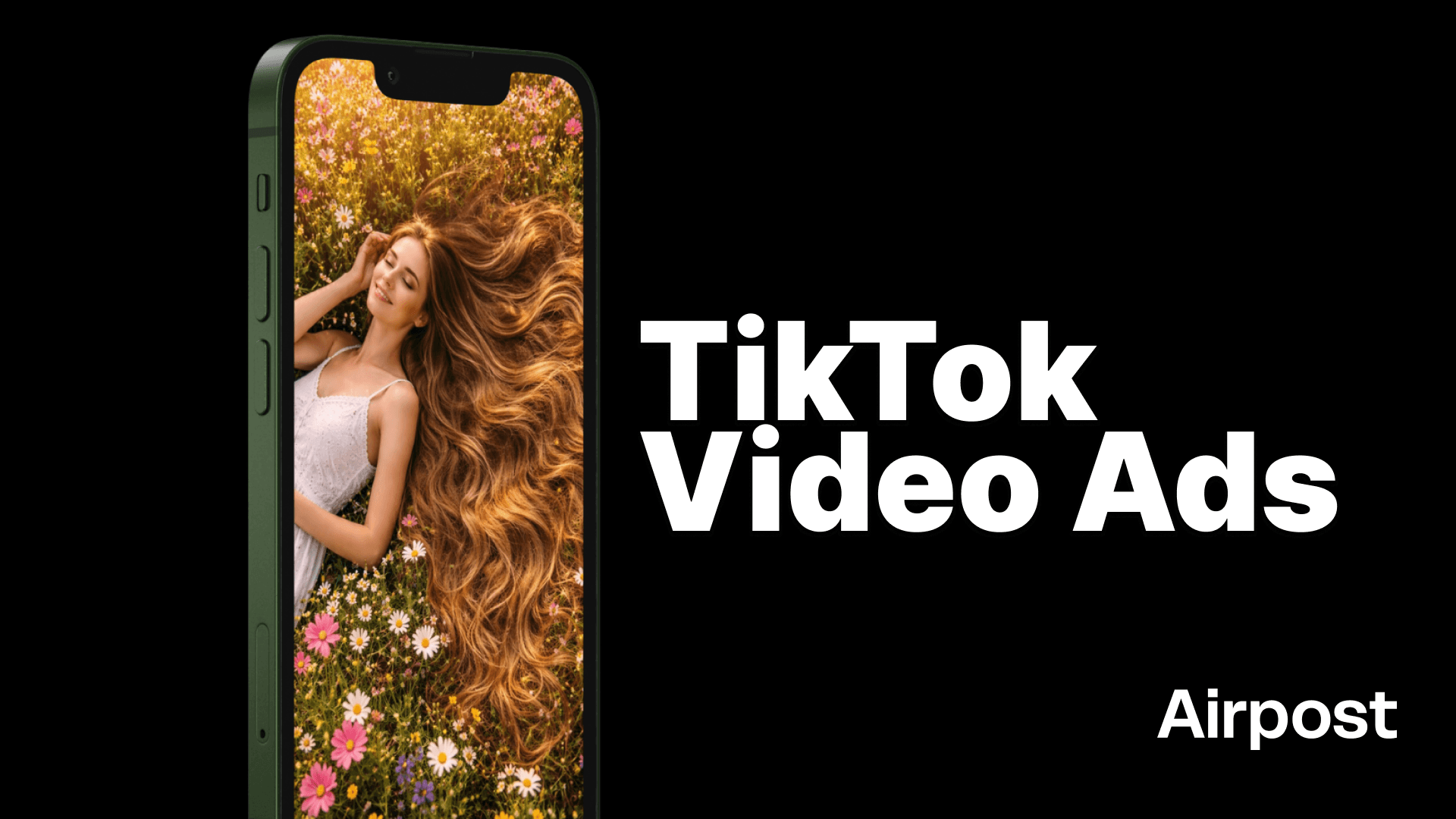
People blame short attention spans for why their TikTok ads get skipped. But the same audience binge-watching Season 6 of a show at 2 am isn't struggling with attention. They're struggling with your ad. The real issue is that most ads feel like ads. They interrupt instead of earning interest. TikTok users want to be entertained, taught something, or shown a perspective they haven't considered. They don't want to be sold to in the first frame. The brands that stop the scroll understand this: the ad has to feel like content worth watching before it gets to act like an ad.
This guide covers how to build TikTok video ads that earn attention instead of demanding it, and how to produce enough of them to keep your campaigns converting.
How TikTok's Algorithm Decides Which Ads Win
TikTok evaluates every piece of content, paid or organic, on the same core signals: watch time, completion rate, engagement, and rewatch behavior. Ads that perform well on these signals get pushed to wider audiences. Ads that don't get buried fast. Follower count and budget size don't override weak creative.
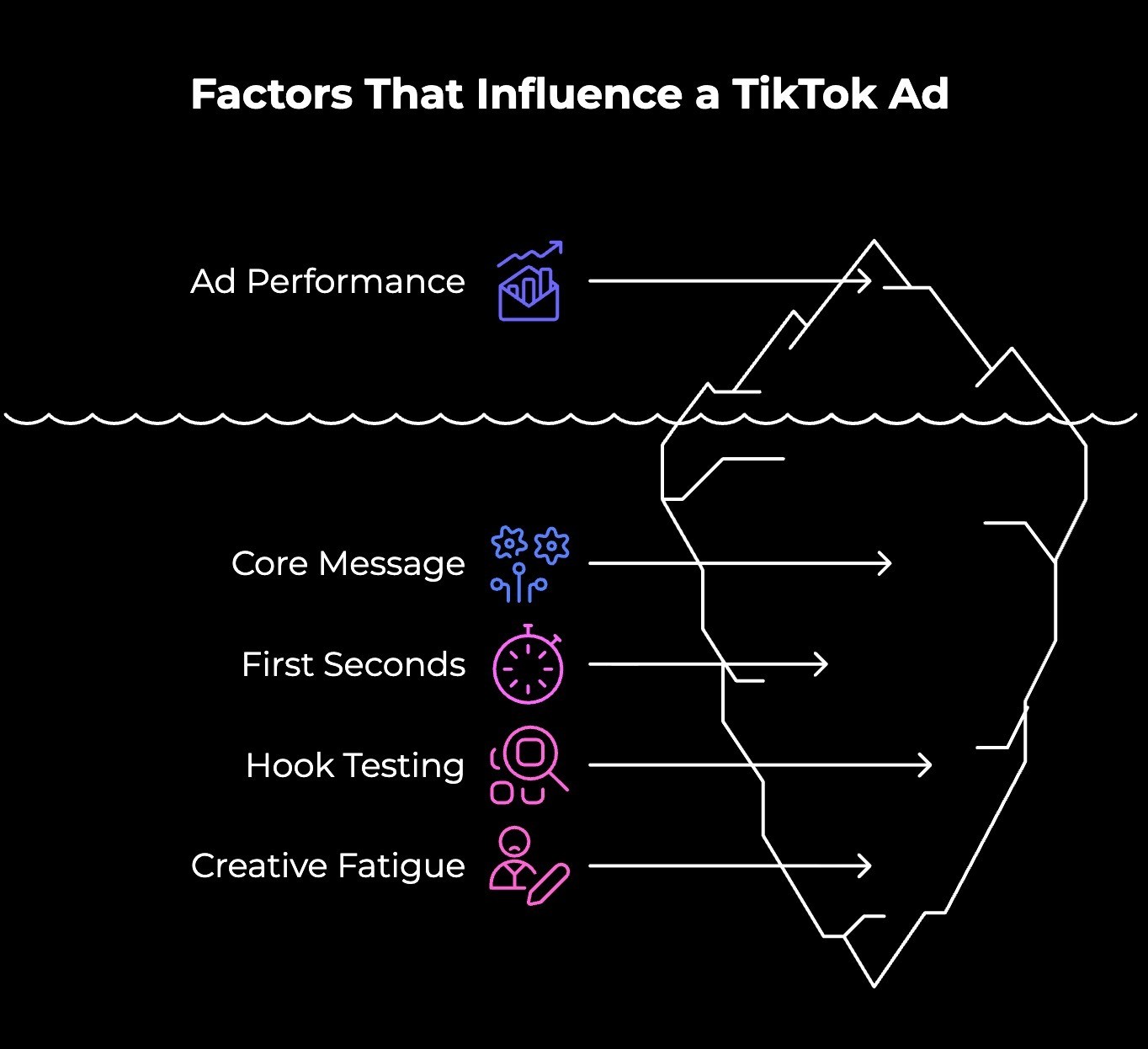
The First Seconds Decide Everything
TikTok's own best practices recommend introducing your content proposition in the first 3 seconds for better recall, and prioritizing your hook in the first six seconds to boost watch time. That's a tight window. Your opener needs to earn the next few seconds before the viewer's thumb flicks upward.
This is why the opener is the single most tested element in high-performing TikTok accounts. It's not about finding one perfect hook. It's about testing dozens of hooks across different angles, audiences, and emotional registers until you find the ones that hold.
Creative Fatigue Is the Default State
TikTok's content cycle moves faster than any other platform. So check ad performance regularly and refresh creatives when delivery results show a consistently declining trend. In practice, that means refreshing every two to three weeks. The platform values timeliness over polish. A good-enough ad that rides a current trend will outperform a perfect ad that ships two weeks late.
What Makes a TikTok Ad Actually Convert
The ads that drive results on TikTok share a few structural traits. They look native, follow a clear persuasion sequence, and come from deliberate strategic choices rather than guesswork.
Look Like Content, Not Like an Ad
The algorithm favors authentic, creator-style content. Polished studio ads trigger immediate scroll-past behavior. The production style that works on TikTok is intentional but casual: good lighting and clean audio, delivered in a way that feels like a real person talking, not a brand broadcasting.
TikTok is sound-on by default. Music sets the pacing and emotional tone of the ad. Use commercially licensed tracks from TikTok's library, trending sounds where they fit naturally, or a voiceover that matches the casual, direct delivery the platform rewards. Design for sound-off too, with captions and text overlays that carry the message visually.
This is also why Spark Ads consistently outperform standard in-feed ads. They're a native ad format that allows you to boost organic content.
Follow a Proven Narrative Structure
Every high-performing TikTok ad moves through a clear sequence:
Opener: The hook. A headline, visual, and sound that grab attention in the first two to three seconds. A bold claim, a question, a pattern interrupt, or a direct callout ("If you're over 40 and still being told to just eat less, listen up"). The goal is to earn the next few seconds.
Bridge: The transition from curiosity to context. Why should the viewer keep watching? This is where you set up the problem or the promise.
Body: The persuasion layer. Product demos, social proof, feature breakdowns, and before-and-after transformations. This is where you prove the claim the opener made.
Outro: A clear call to action. Keep it short. Momentum dies fast at the end of a TikTok video.
Fifteen to thirty seconds is the sweet spot for most in-feed ads. Long enough to deliver a complete argument, short enough to hold attention through to the CTA.
Build Each Ad from Strategic Layers
The difference between a team churning out random videos and one producing ads that convert is how systematically they approach creative decisions. Each ad should be built from four layers:
Angle: This is the core message. "Cheaper than the alternative," "clinically proven," "no lifestyle change needed." Each angle bundles related product facts into a single testable idea.
ICP: Who are you talking to? Same angle, different language for a busy parent vs. a skeptical professional. Demographics, behaviors, pain points, and objections shape the copy.
Tactic: The psychological mechanism. Myth-busting, social belonging, transformation proof, us vs. them, skeptic-to-believer. This determines how the ad convinces.
Creative format: The visual structure. Testimonial, explainer, listicle, montage, get-ready-with-me, podcast clip, street interview. This determines how the ad looks and feels.
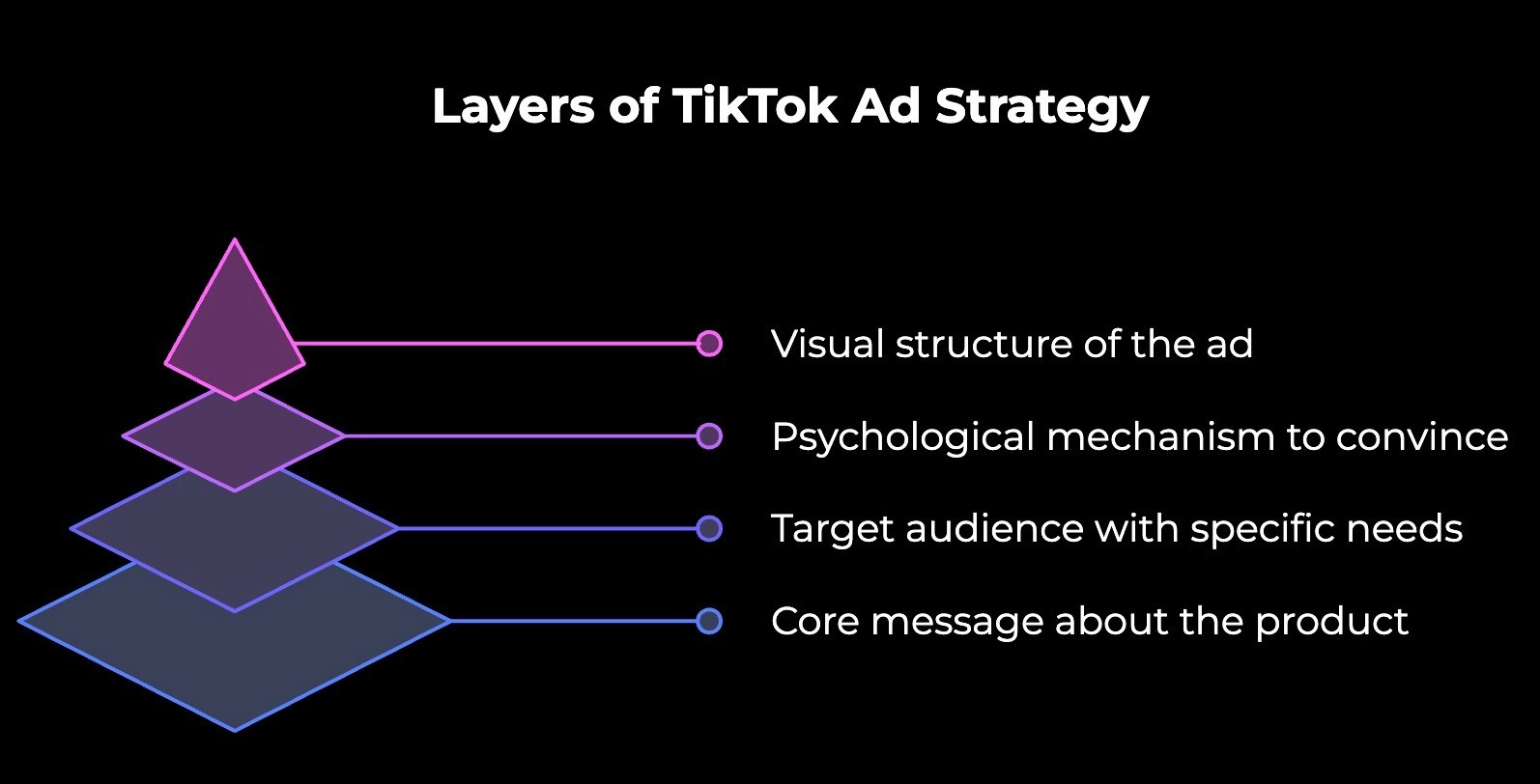
These layers are independent. One angle can run across multiple ICPs, tactics, and formats. That's how you generate genuinely diverse creative from a manageable set of inputs, instead of reinventing everything for each new ad.
Campaign Setup That Supports Creative Testing
Great creative can't save a broken campaign structure. A few setup decisions make the difference between useful data and wasted spend.
Run 3 to 5 Creatives per Ad Group
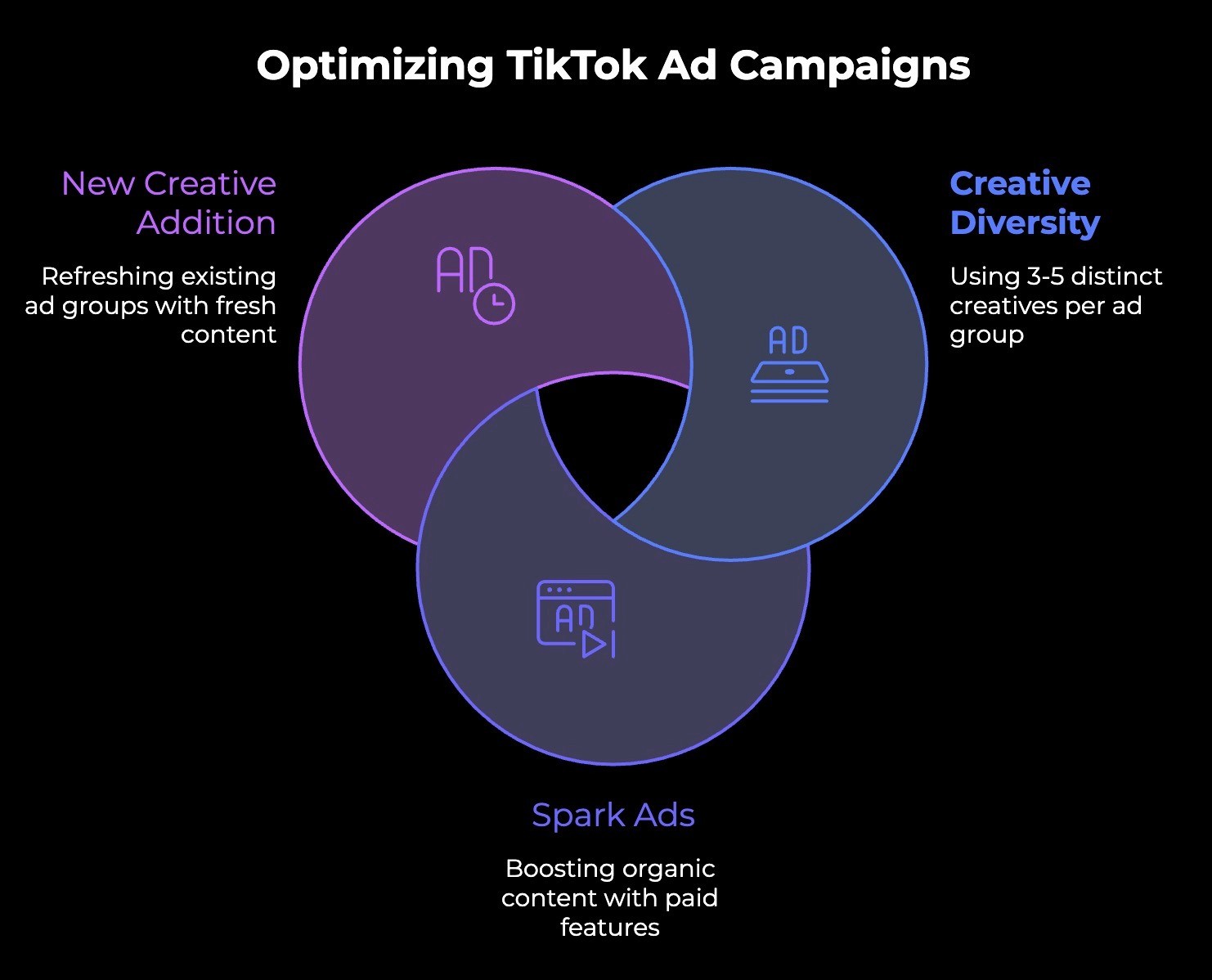
TikTok recommends three to five different creatives per ad group and three to five diversified ad groups per campaign. The keyword is "different." Three minor variations of the same concept won't give the algorithm enough signal. Each creative should represent a distinct combination of angle, tactic, or format.
Use Spark Ads to Boost What's Already Working
Spark Ads let you turn organic TikTok videos into paid ads while keeping the native feel and functionality of a regular post. Users can still like, comment, share, duet, and visit your profile, so the ad builds your account while driving conversions.
Spark Ads see a 134% higher completion rate and 157% higher 6-second view-through rate compared to standard in-feed ads. The profile landing page feature drives a 69% higher conversion rate and 37% lower CPA.
Use them when you want to put paid spend behind organic content that's already gaining traction, when boosting creator partnerships, or as part of an always-on strategy that blends organic and paid.
Add New Creatives to Existing Ad Groups
When it's time to refresh, don't spin up a new ad group. Add new creatives to an existing ad group to extend its lifetime. New ad groups reset the learning phase. Adding fresh creativity to a proven group lets the system build on existing optimization data.
Iterating on What Works
Launching ads is the start. The campaigns that sustain performance follow a clear iteration playbook.
When an ad starts performing, extend its lifespan by refreshing what decays while protecting what converts:
Swap footage but keep the script and voiceover intact.
Recut the opener based on hook-rate data. If the first three seconds aren't holding, test a new visual or headline while keeping the body.
Take the opener from one top performer and pair it with the body of another.
Keep the same angle and ICP, but switch the tactic. If a testimonial worked, try the same message as a myth-busting explainer.
Hook rate flags opener problems. Post-hook retention flags bridge or body issues. Average view time tells you whether the ad is too long, too short, or losing people at a specific moment.
Create Winning TikTok Video Ads With Airpost
Producing this volume and diversity manually is where most teams stall. And even if you use self-serve AI video tools, you'll hit a ceiling fast. They can generate footage, but they can't build a creative strategy, maintain brand tone across hundreds of ads, or manage compliance. You need tools like Airpost that merge human intelligence with AI.
Airpost delivers 10 to 30 done-for-you video ads per week through a hybrid engine that combines AI production with expert creative strategists. You set a living brief, and the system builds, tests, and iterates on your behalf.
What sets Airpost apart is its proprietary ad taxonomy. Every creative is categorized by angle, ICP, tactic, creative format, hook type, and performance pattern. This framework identifies white space in your strategy: which audience-message combinations haven't been tested, which formats are underexplored, and where the next winning concept is likely hiding.
The engine draws from over 300,000 real footage clips, generates AI footage for your products, automatically resizes to vertical and square formats, and monitors performance 24/7. When an ad starts winning, the system triggers new variations. Creative strategists validate every output for brand safety, compliance, and quality.
Book a demo to see how Airpost builds high-volume TikTok campaigns that keep converting.