HeyGen is the AI avatar video tool most performance marketers run into first. It's fast, the avatars are convincing, and the free plan is low-friction enough that almost anyone can use it to create a quick video. But before you sign up for the tool, you would want to know whether a $29 or $149/mo subscription replaces a chunk of their content production workflow.
This review covers what HeyGen does, how the 2026 pricing actually works (including the part most articles get wrong which is, the API cost), and where the tool stops being of much use for paid social teams.
What is HeyGen AI?
HeyGen is an AI video generation platform that turns scripts into talking-head videos featuring photorealistic avatars. You paste a script, pick an avatar (stock, photo-based, or a custom digital twin of yourself), pick a voice, and HeyGen generates a video where the avatar speaks your script with synced lip movement, gestures, and intonation.
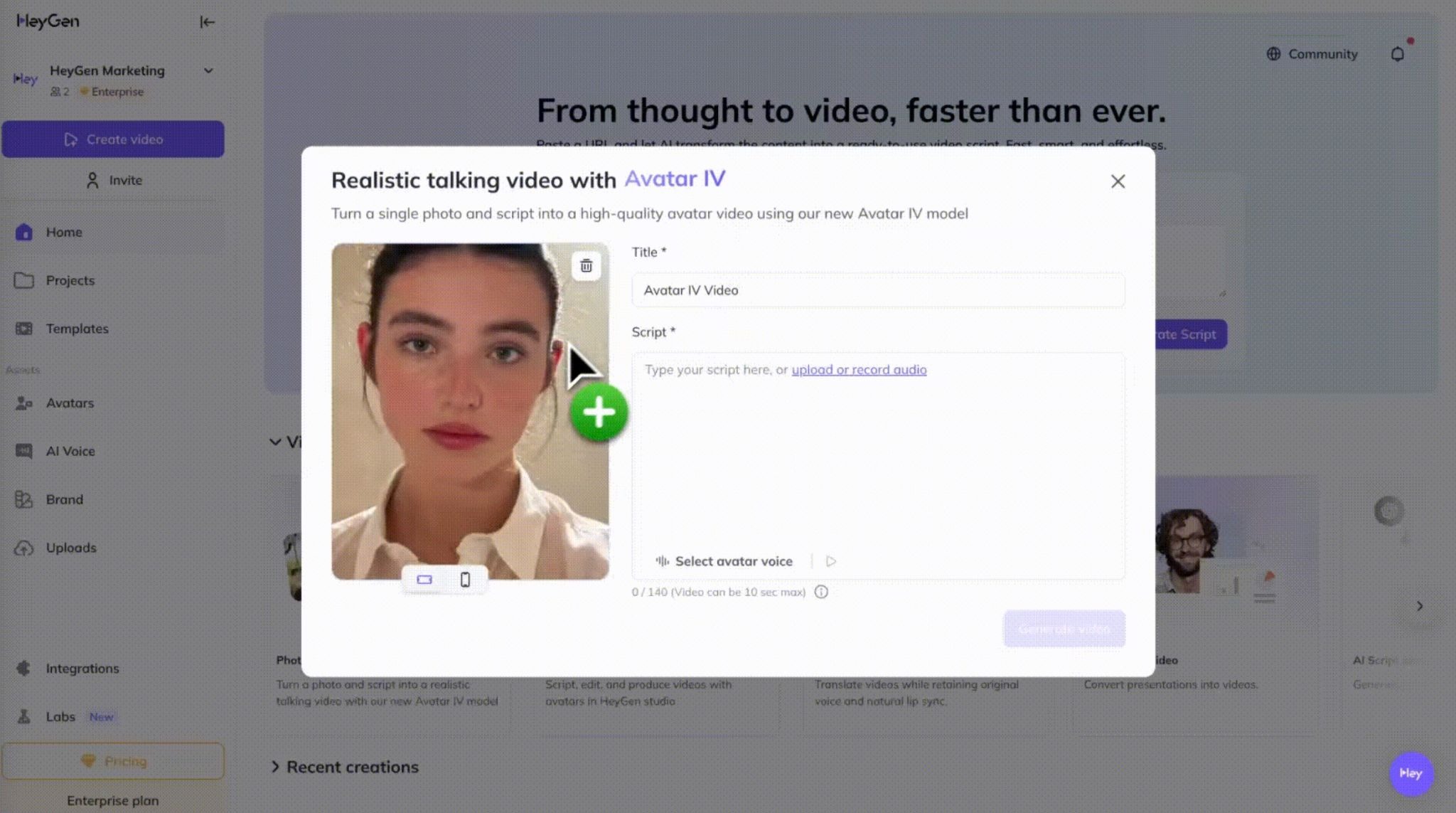
The core product is the Avatar IV engine, launched in mid-2025 and updated through early 2026. It even reads the emotional register of your script and outputs natural micro-expressions, head movement, and timing-aware hand gestures. It also includes a video translator (175+ languages with lip-sync), a voice cloning tool, an LLM-driven Video Agent that builds a full video from a single prompt, and a developer API.
For a wider read on the category, see best AI ad generators and our HeyGen alternatives article.
Key features of HeyGen in 2026
These are the key features that matter most for marketers and L&D teams:
Avatar IV with motion and gesture control. The current-generation engine produces 30-minute videos with timing-aware gestures and emotional micro-expressions.
Photo Avatars and Digital Twins. Photo Avatars turn a still image into a talking avatar; Digital Twins are full custom avatars trained on a short video recording of yourself (Creator plan and up).
Video Translator with lip-sync. Dub into 175+ languages with the original speaker's voice cloned and lip movement re-synced. As of February 2026, audio dubbing is unlimited on all paid plans and doesn't consume premium credits — meaningful if localization is your primary use case.
Voice Cloning. Unlimited voice clones from the Creator plan upward.
Video Agent 2.0. A workflow that takes a single text prompt and assembles a full video — script, avatar, voice, B-roll, transitions.
LiveAvatar. Real-time interactive avatars over WebRTC, connectable to any LLM. Use case: 24/7 live sales or support agents that respond to viewer comments.
Interactive Video, Quizzes, SCORM, LMS integrations. Business plan and up, built for training workflows.
Integrations and developer surface. Native n8n, Make, HubSpot, Zapier on Business; direct API, MCP server, and HeyGen Skills for agent frameworks.
A deep dive into HeyGen pricing in 2026
HeyGen runs a five-tier web pricing model plus a separate pay-as-you-go API plan. The web plans are credit-based. Each ships with a monthly credit allowance, and different features burn credits at different rates.
Is HeyGen free?
HeyGen offers a permanent free tier with no credit card required: 3 videos/month, 1-minute max, 720p, access to Avatar IV and Video Agent (with the duration cap), 500+ stock avatars, 1 custom Digital Twin, 30+ languages, and a HeyGen watermark on exports. This is enough to validate whether the tool works for you or not.
Paid plans at a glance
Plan | Monthly | Yearly (eq./mo) | Credits / mo | Max video | Resolution | Key unlocks |
Free | $0 | — | — | 1 min | 720p | 3 videos/mo, watermark |
Creator | $29 | $24 | 600 | 30 min | 1080p | Watermark removal, voice cloning, 175 languages, credit rollover |
Pro | $49 | ~$39 | 1,000 | 30 min | 4K | Customizable usage, edit/proofread translation scripts |
Business | $149 + $20/seat | ~$119 | 1,500 | 60 min | 4K | 5 Digital Twins, SAML/SSO, interactive video, SCORM, LMS, Zapier/n8n |
Enterprise | Contact sales | — | Custom | Unlimited | 4K | SCIM, MFA enforcement, multi-workspace control, commercial terms |
Annual billing drops monthly cost by roughly 17–20%. Credit add-on packs are available at $15 for 300 premium credits, $150/year for the annual equivalent. You can use these for months where you run over your allowance.
How do HeyGen credits actually work?
Credits are not minutes. Different features deduct at different rates:
Avatar III videos: 3 credits per minute
Avatar IV/V videos: 20 credits per minute
Audio dubbing (no lip sync): 2 credits per minute
Full video translation with lip sync: 5 credits per minute
Video Agent (prompt-based generation): 20 credits per minute
The Creator plan's 600 monthly credits give you about 30 minutes of Avatar IV video, or 60–120 minutes of translated video with lip-sync, or some combination. If you mostly generate Avatar IV ads, 600 credits gets you about 60 30-second ads. It works fine until you start iterating across hooks, copy, and avatars.
The "expensive" complaint pattern in G2 and Trustpilot reviews of HeyGen is almost always about this credit math rather than sticker price. People assume their monthly fee buys minutes. It buys credits, and the credit-to-output ratio varies by feature.
HeyGen API cost explained
The web plan is for hands-on use. You log into HeyGen's studio, pick an avatar, type or paste your script, customize the look, and hit generate. It's built for individuals and teams who want to create videos directly inside the platform. The API plan is a different track entirely. You'd need this if you want to build HeyGen's video generation into your own tools, automate production through code, or plug it into a larger workflow without anyone manually clicking around in the HeyGen studio.
Funding one does not fund the other.
So if you're using HeyGen both through the studio for one-off projects and through the API for automated workflows, you're paying into two different accounts. For most people producing social media ad creatives manually, the web plan is probably sufficient. The API becomes relevant when you're producing at a volume where logging into the platform and generating one video at a time stops making sense.
HeyGen restructured its API in February 2026 to pay-as-you-go:
Minimum top-up is $5, credits expire 12 months after purchase, no monthly commitments, and no free API credits.
Enterprise includes everything in Pay-As-You-Go plus customized scalability, dedicated developer support, Digital Twin Creation API, Proofread API, and discounted rates.
When HeyGen DIY is enough and when you need a team
For a lot of teams, HeyGen on its own is the right answer:
Solo creators and founders shipping sales videos, demos, or LinkedIn content a few times a week
Internal communications and L&D teams producing all-hands recordings, onboarding, compliance training — the Business plan's interactive video, SCORM export, and LMS integrations are genuinely strong here
Localization-heavy teams dubbing webinars, training, and recorded podcasts (unlimited audio dubbing on paid plans makes this a real cost story)
Agencies running one-off avatar projects for clients such as explainers, product launches, multilingual versions of existing assets
Developers and product teams embedding avatar generation into their own software via the API, including real-time interactive avatars
For these profiles, start with the free tier, validate the avatars and voice, then upgrade only when you have a clear monthly volume you're working against.
You're likely better served by a fractional creative team if:
You're running paid social as a real growth channel and need 50+ tested variants per month
The bottleneck in your team is "what do we test next?" rather than "how do we make it?"
You need AI avatars for ads plugged into a broader testing system with statics, UGC, and Runway ML or live-action footage
You need a fractional creative director or to hire a creative strategist but aren't ready to commit to a full-time headcount
HeyGen replaces the cost of a video editor for UGC-style videos, or AI-avatar style videos. It does not replace the strategist, the brief writer, or the analyst who closes the loop between ad performance data and next week's creative. For most companies running paid social at scale, those three roles require a lot of coordination, and that's where a fractional team earns its keep.
Where HeyGen stops working for scaling paid social teams
HeyGen is excellent at what it does. But if you are trying to scale your paid social media, then it might not serve your purpose.
1. The tool generates videos. It does not generate winning angles.
HeyGen will produce a clean 30-second avatar ad in 10 minutes. It will not tell you which hook to use, which pain point to lead with, or which CTA works on cold traffic vs warm. Those are creative strategy decisions, and the tool is silent on all of them. Most teams realize this around month two, when the first batch of avatar ads underperforms and there's no obvious next move except "try another script."
2. Volume math breaks faster than expected.
A serious paid social account needs 8–30 fresh creative variants per ad set per week to maintain auction performance. A team across three audiences and two products is looking at 50–200 net-new variants per month. HeyGen can technically produce that volume. The work of writing, briefing, reviewing, tagging, QA-ing, uploading, and analyzing those variants does not collapse just because the rendering step is fast.
3. Avatar fatigue is real and arrives quickly.
Customer-acquisition feeds get crowded with AI avatars fast in 2026. Teams that lean too hard on a single Digital Twin see CPMs creep up and CTRs flatten within weeks. The fix is creative diversity. You need different avatars, mixed avatar/live-action, statics-and-motion combinations. HeyGen is one input into that mix, not the whole system.
HeyGen vs Synthesia: a side-by-side comparison
The most common HeyGen comparison is against Synthesia.
Dimension | HeyGen | Synthesia |
Starting price | $29/mo monthly ($24/mo annual) | $29/mo monthly (~$18/mo annual) |
Stock avatars | 500–700+ | 240+ |
Languages | 175+ | 140–160+ |
Custom avatars | From Creator plan; one-time fees from ~$99 | Enterprise only, annual contracts starting around £8,000+ |
Max export resolution | 4K (Pro and up) | 1080p |
Avatar quality (Avatar IV) | Industry-leading lip-sync and micro-expressions | Strong, more "corporate-clean" feel |
API | Pay-as-you-go, $1–$5/min depending on feature | Available, enterprise-tier pricing |
Best fit | Outward-facing content: ads, social, localization | Internal: training, L&D, governance-heavy environments |
HeyGen wins on quality, language coverage, and custom-avatar accessibility. Synthesia wins on structured enterprise workflows, brand governance, and team-of-50+ collaboration. For paid social and ad iteration, HeyGen is the more natural choice. For compliance-heavy training rolled out across a global workforce, Synthesia is great.
When you've outgrown HeyGen, Airpost comes in
HeyGen is the right tool when you're producing under 5-70videos a month, you already have a clear strategist on your side. For solo creators, internal communications, training, and localization-heavy use cases, HeyGen does the whole job.
But for brands that want 10-30 creatives every month to scale their paid ads, you need different tools. The problem you hit at higher volume isn't the rendering engine. It's everything around it, such as generating fresh angles every week, briefing them, producing them across formats, uploading and tagging cleanly, and tying performance signals back into next week's pipeline.
That's the gap Airpost is built for.
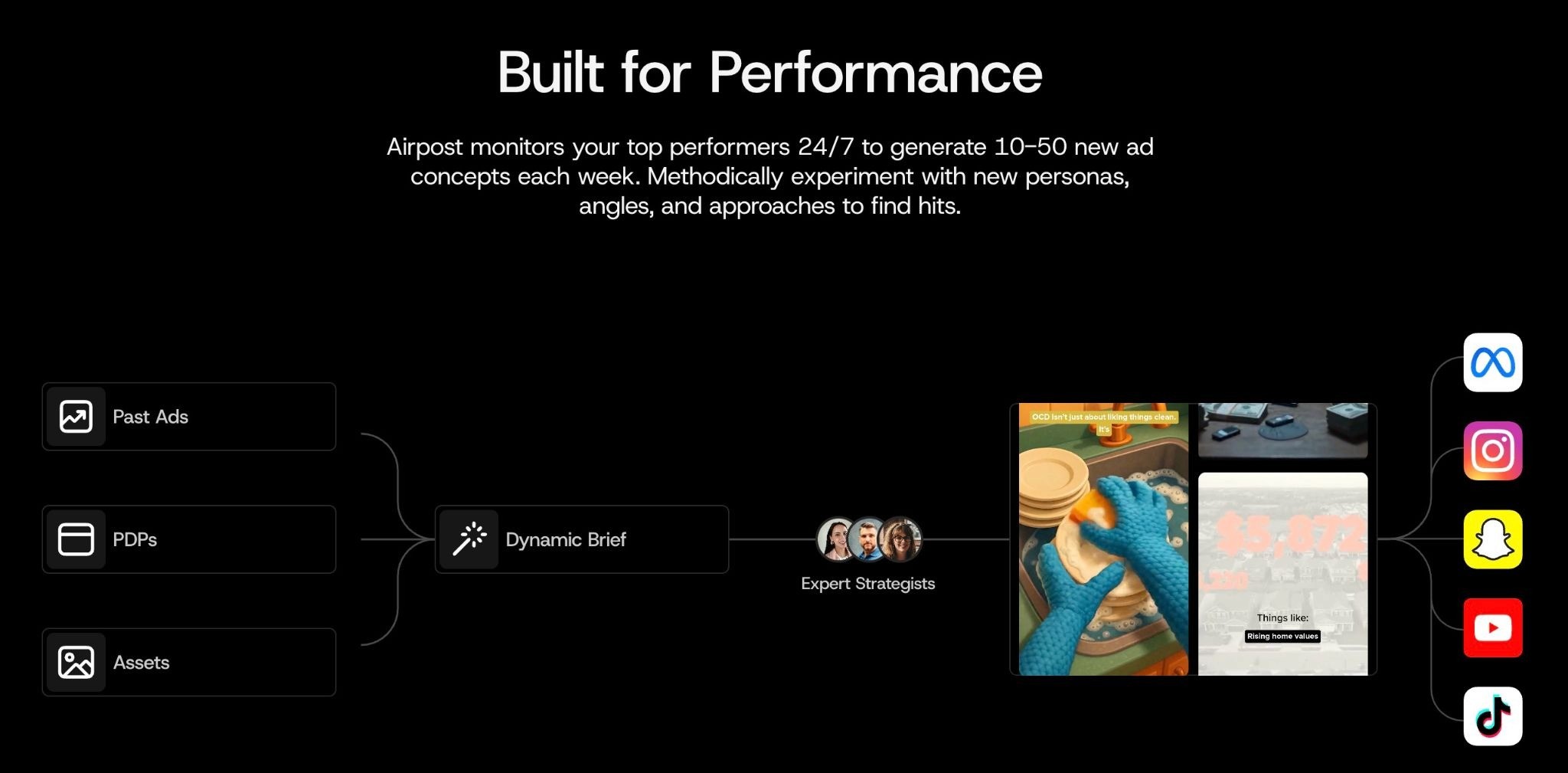
Airpost is a hybrid AI ad creative platform. It has a proprietary AI engine managed by expert creative strategists. You upload your brand kit, past ads, product data, and footage; Airpost's engine combines your assets with its own stock and AI-generated footage, and strategists shape the output into 10–30 new ad concepts per week, testing new personas, angles, and value props against what's already working in your account.
How it fits a paid social team's workflow?
Living briefs that update your ads when you adjust them. Native integrations with Google Drive, Dropbox, and DAMs to pull in assets. Google Sheets sync so approvals and uploads land where your ops team already lives.
Who it's for?
Performance marketing teams at companies like DoorDash and Cloaked, running paid social as a real growth channel, who need creative velocity and creative diversity at a cost-per-creative low enough to test ads freely.
If your bottleneck is scaling paid social, not rendering avatar videos, browse ad examples, and book a demo.
FAQ
Is HeyGen safe to use?
Yes, for most commercial use cases. HeyGen offers SAML/SSO, SCIM, MFA, GDPR compliance, and a public security portal; Enterprise plans add audit logging and commercial terms. The two real risk areas are (1) deepfake and likeness misuse, which HeyGen's moderation policy explicitly prohibits, and (2) usage rights on stock avatars and voices. These are permitted for commercial purposes, but worth reading the terms before scaling.
Can you use HeyGen for ads?
Yes. HeyGen's terms permit commercial use including paid advertising, as long as inputs comply with their content guidelines. Many teams already run HeyGen creative on Meta, TikTok, YouTube, and LinkedIn.
Does HeyGen include a commercial license?
Yes. All paid plans include commercial use rights. The free plan permits commercial use with the HeyGen watermark. Enterprise plans add explicit commercial terms negotiated as part of the contract.
HeyGen vs hiring a creative team. Which is cheaper?
It depends on volume. HeyGen Business plus a few seats runs $200–$400/month. A fractional creative team sits in the low- to mid-four-figures. The honest comparison isn't tool-vs-team. It's "tool plus internal time" vs "tool plus external team." Most paid social teams spend 15–40 hours/week on creative coordination once they cross 50 variants/month. At a loaded internal cost of $75–$150/hour, that catches up to a fractional team's monthly fee quickly.
HeyGen vs Airpost. What's the difference?
HeyGen is an AI avatar video tool. You log in, write a script, and generate a video. Airpost is an AI video ad platform for teams that need a steady stream of high-quality performance creatives. Instead of leaving you alone with a tool, Airpost pairs its AI engine with a creative strategist who helps shape scripts, angles, and brand tone. If you're running paid social as a real growth channel and the bottleneck is "what do we test next?" rather than "how do we make it?", Airpost replaces the strategic and operational layer.