Instagram is no longer the photo-sharing app it launched as in 2010. With over 3 billion monthly active users and a platform that now heavily prioritises video, it has become one of the most effective paid channels for brands of every size.
But simply uploading a video and throwing a budget behind it won’t cut it. The difference between an ad that gets swiped past in half a second and one that drives real conversions comes down to format selection, creative execution, and best practices for creating ads.
This guide covers which Instagram video ad formats actually drive results, what specs and creative styles work in each placement, and best practices to create winning ads.
Instagram Video Ad Formats: A Detailed Breakdown
Instagram supports several video ad placements, and each one behaves differently. The format your ad runs in changes how people see it, how long they watch, and what kind of creative holds their attention.
1. Reels Ads
Reels has been Instagram's flagship video format since IGTV was folded into Instagram's broader video experience. It is the highest-reach video placement on the platform, and Reels ads appear in between organic Reels as full-screen, vertical ads.
Key specs:
Aspect ratio: 9:16 (1080 x 1920 px)
File format: MP4 or MOV
Safe zones: leave roughly 14% of the top, 35% of the bottom, and 6% on each side free from text, logos, or key creative elements
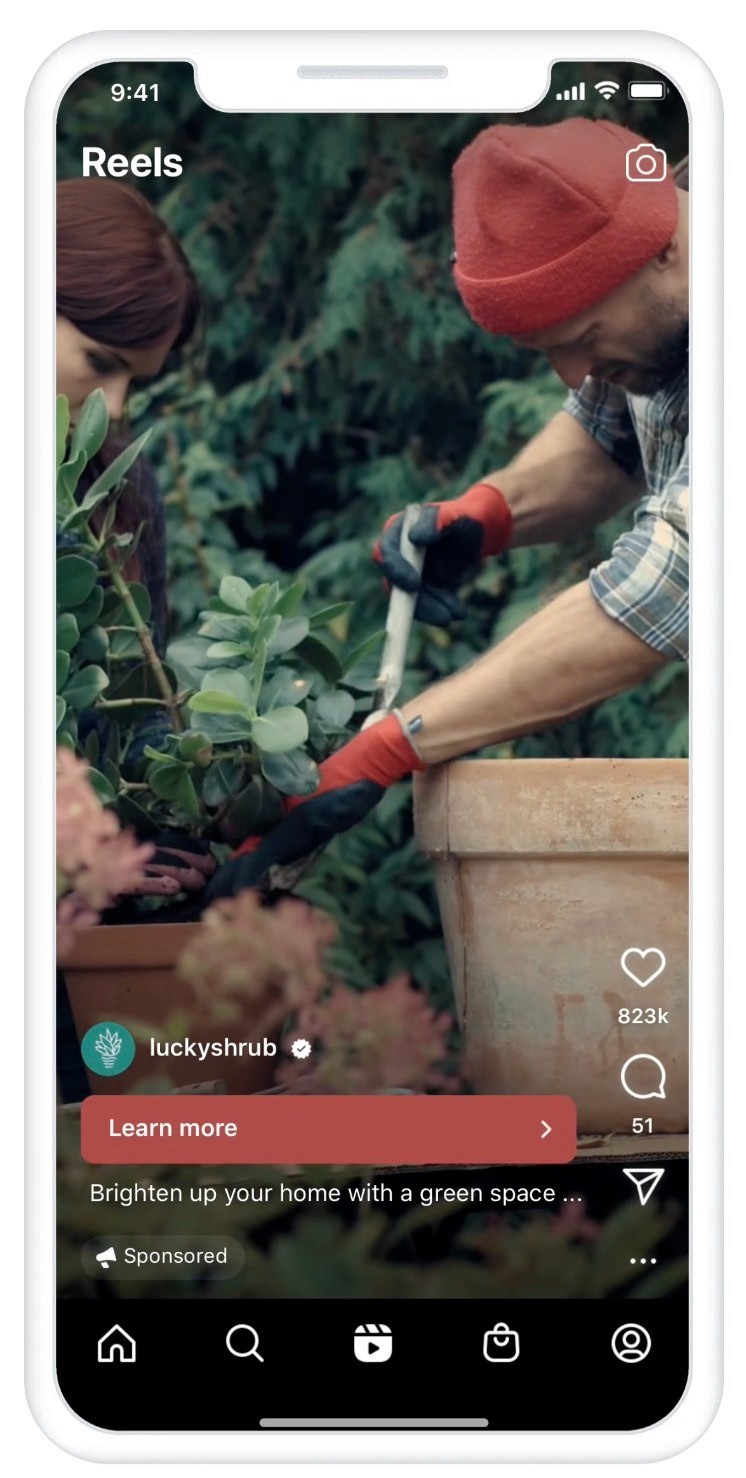
Instagram reel ad Source
The best Reels ads don't feel like ads. They feel like content: fast hook, clear story, and a payoff. UGC-style creative, talking-head hooks, and text-led storytelling tend to perform well here. If your ad looks like a polished TV spot dropped into someone's feed, expect a quick scroll past.
2. Stories Ads
Stories ads are full-screen and vertical, appearing between organic Stories from accounts people follow. They are tappable and skippable, which makes the first frame do most of the work. You have roughly 1-2 seconds before someone decides to tap forward.
Key specs:
Aspect ratio: 9:16 (1080 x 1920 px)
Video ads under 30 seconds play in their entirety. Anything longer may be split into separate Stories cards, typically 15-second segments.
Safe zones: leave 14% (250 pixels) at the top and 20% (340 pixels) at the bottom to avoid overlap with profile icons and CTAs
File format: MP4 or MOV
What works here: bold text overlays, quick product demos, single-message creatives, and direct CTAs. Think of Stories ads as billboards with motion. One idea, delivered fast.
3. In-Feed Video Ads
Feed video ads appear between organic posts on Instagram's newsfeed and auto-play muted by default. That single detail should shape every creative decision for this placement. If your video relies entirely on voiceover or dialogue, it will underperform in Feed.

In-feed ad on Instagram source
Key specs:
New for 2026: 3:4 aspect ratio (1080 x 1440 px) is now fully supported and recommended for maximum vertical impact
Square (1:1 at 1080 x 1080 px) is also supported, but takes up less screen space
File format: MP4 or MOV
Captions and text overlays are not optional here. They are the primary way your message reaches sound-off viewers. Visually led creatives with clear text hierarchy, product-focused videos with benefit callouts baked into the video, and comparison-style ads where the visuals do the convincing all perform well in Feed. Pacing can be slightly slower than Reels since feed scrolling is more deliberate.
4. Explore Ads
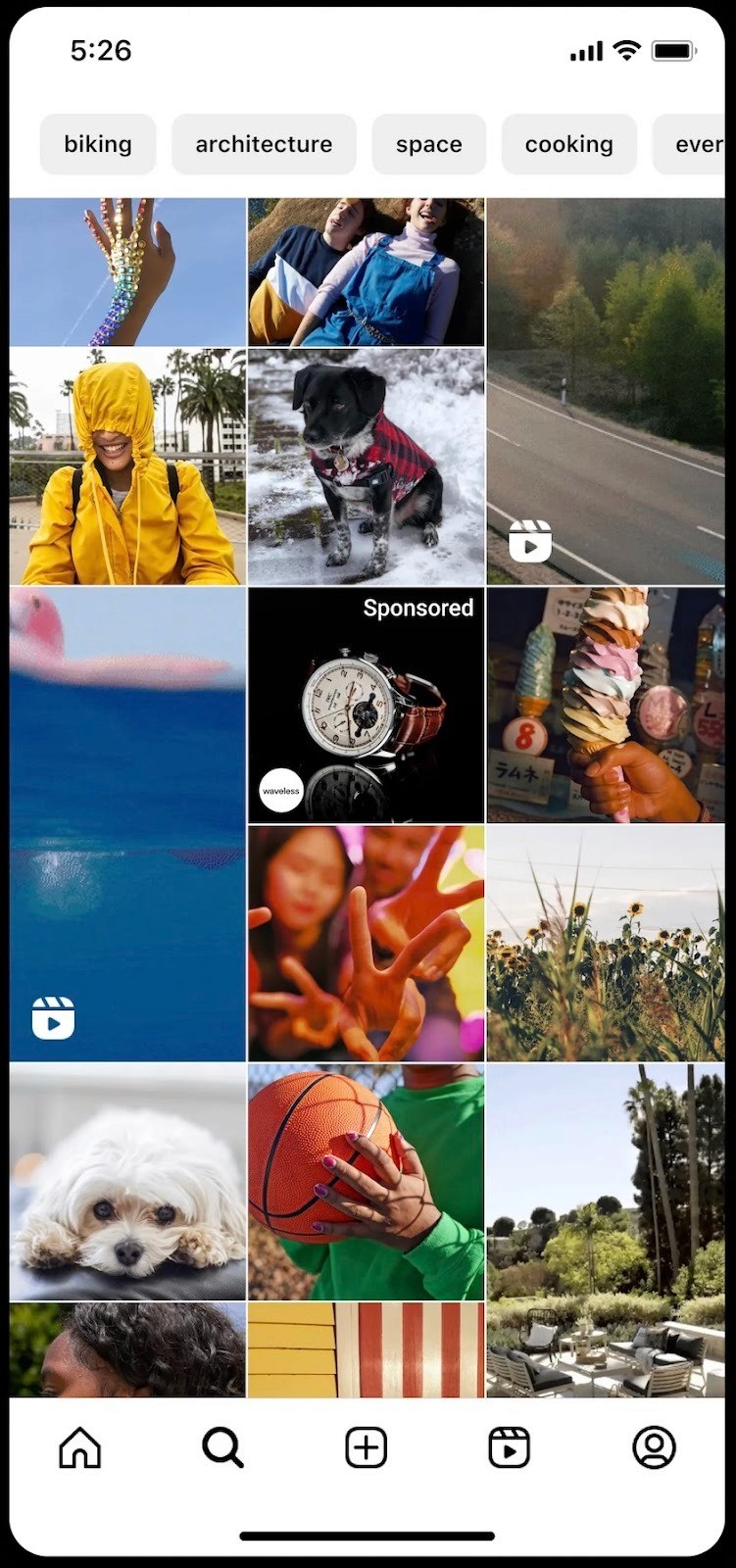
Explore is Instagram's discovery engine, where people go when they are in "show me something new" mode. Explore ads appear in the Explore tab, either among the discovery grid or in the feed that appears after someone taps a piece of content from Explore.
Key specs:
Instagram suggests a square 1:1 for best results in Explore, since the grid is tiled squares
4:5 and 9:16 are also supported
The difference with Explore is intent. People browsing here are not searching for your brand. They are passively open to discovering something new, which makes bold hooks and curiosity-driven openings especially effective. This placement rewards creative diversity because the algorithm is actively matching content to individual user interest signals.
3 Best Practices for Instagram Video Ads
Getting the format right is table stakes. What separates ads that burn budget from ads that scale is the creative itself.
1. Win the First Few Seconds or Lose the Viewer Entirely
Viewers decide whether to keep watching within roughly the first 1 to 2 seconds of your video ad whether it's a reel or a story. They need a reason to stop before they have time to think about scrolling.
Three opener styles that consistently earn attention:
A direct statement that creates tension. "You are applying sunscreen wrong" will stop more people than "Here are our top skincare tips." Lead with a claim that forces the viewer to wonder if it applies to them.
A visual that breaks the scroll pattern. Close-up product shots, unexpected textures, hands doing something unusual. Anything that looks different from the organic content surrounding it will hold the viewer for longer.
Text-first hooks on a bold background. Especially in Feed and Reels, a single line of large text ("This costs $4 and replaced my entire morning routine") can outperform talking-head openers because it reads instantly, even at scroll speed.
2. Build Every Ad for Sound-Off First
Feed video ads auto-play muted by default. And while Reels and Stories are more sound-on environments, a significant portion of viewers still watch without audio, as they might be in public, at work, or just scrolling late at night.
If your ad does not make sense on mute, it does not work for a large chunk of your audience.
This does not mean voiceover and music are wasted. It means they should add to a video that already communicates visually. Here is what that looks like:
Captions on every ad, every time. Not auto-generated captions buried at the bottom. Styled, readable text that follows the pacing of the script and sits within safe zones.
On-screen text that carries the narrative. If your voiceover says, "This ingredient reduces redness by 40% in two weeks," that claim should also appear as a text overlay. The viewer who never turns on the sound should still get the full message.
Visual proof over verbal claims. A before-and-after shot, a screen recording of real results, or a product demo shown in close-up all communicate without a single word of audio.
Before you publish, watch your ad on mute with no context. If you cannot tell what the product is, what it does, and why you should care, the creative needs more work.
3. Test Different Concepts, Not Minor Tweaks
This is where most Instagram ad strategies fall apart. Teams produce one strong video, then create five variations by swapping the background color or changing the CTA button text. Performance barely moves, and they conclude that creative testing does not work.
The problem is not testing. The problem is what they are testing.
Meta's ad distribution system evaluates creatives using visual and text embeddings to understand what each ad is about. When two ads look and sound nearly identical, the algorithm treats them as essentially the same creative. It will not distribute widely because there is nothing new for it to learn from the second version.
What the algorithm rewards is genuine diversity. Ads that look, feel, and argue differently from each other.
Instead of changing one variable at a time, test across these dimensions:
Different angles. One ad leads with price. Another leads with a customer pain point. A third opens with social proof. Same product, completely different entry points.
Different visual styles. A polished studio ad, a raw UGC-style testimonial, and a text-on-screen explainer will each reach different segments of your audience, even with the same core message.
Different creative formats. A 15-second product demo, a 30-second story-driven ad, and a quick listicle ("3 reasons this works") give the algorithm distinct signals to test against distinct audience clusters.
The brands scaling Instagram ads in 2026 are not optimizing one hero video. They are producing 10 to 30 distinct creatives per week, each with a different combination of hook, angle, and format, then letting performance data tell them where to double down.
Scale Your Instagram Video Ads with Airpost
Winning on Instagram video ads in 2026 requires volume, diversity, and speed. You need multiple creative concepts running across Reels, Stories, Feed, and Explore every week. You need each one to look and argue differently from the last.
Performance teams hit a wall here. The strategy makes sense, but the production does not keep up. Internal teams cannot turn around 15 to 20 distinct video ads per week. Self-serve AI tools can generate volume, but the output rarely meets the quality bar that large brands need.
Airpost solves this by combining AI-powered ad production with expert creative strategists who manage the entire process for you. Airpost delivers 10 to 30 new video ads per week, each one built with strategic intent, not random generation.
Every ad Airpost delivers is categorized using a proprietary ad taxonomy. This system maps each creative across its format, angle, target audience profile, persuasion tactic, and hook type. It is what turns high-volume production into structured, measurable creative testing, rather than just throwing more ads at the wall.
Here's what you get:
Automatic format resizing: Every ad ships in 9:16 and 4:5 with repositioned text and optimized safe margins.
300,000+ real footage clips: Real video from Airpost's proprietary library, your brand assets, and AI-generated footage, mixed to your preference.
A living brief: Creative direction updates based on performance data, so each week's ads build on what is already working.
24/7 performance monitoring: When an ad starts winning, strategists trigger new variations to scale it across hooks, angles, and audiences.
Brand safety and compliance built in: A Disclaimers feature and dedicated strategist review ensure every ad is on-brand before it ships.
Book a demo with Airpost and see how it works for your brand's Instagram video ads.