There's a misconception that a creative strategy has to be born out of a brainstorming session. Just because it has the word "creative" in it doesn't mean that there is no structure or framework to it. That is not a strategy. That is just ideas and gut feelings.
A real ad creative strategy is a system. It starts with the facts about your product, translates those facts into structured angles and audience profiles, defines the psychological and visual mechanics of every ad, and then generates disciplined variations that compound learning over time. The brands that scale creative profitably are not the ones with the best single idea. They are the ones with a repeatable framework that turns product knowledge into dozens of genuinely distinct concepts every week.
This article walks through creative strategy framework step by step, from the foundational product parameters all the way through narrative structure and testing methodology.
Lock In Your Product Parameters First
Before you write a single headline or brief for any ad shoot, you need to document what is actually true about your product. You need to write down the concrete, verifiable facts that you can deploy in an ad to convince someone to buy.
There are eight core parameter categories to work through.
Unique Value Propositions (UVPs): These are short, positive benefit statements that explain why someone should buy this product over alternatives. For a skincare brand, that might be "Reduces dark spots in 14 days" or "Dermatologist-formulated with 15% Vitamin C." Each UVP should be specific enough to stand on its own as a reason to purchase.
Problems Solved: This involves frustrations that make someone eligible for your product. "Uneven skin tone that foundation can't fully cover" or "Breakouts that get worse with every new product." These map directly to the emotional hooks you will use later in scripts.
Steps to Use: A clear sequence showing how the user unlocks the benefit. For a skincare serum: cleanse, apply three drops, follow with moisturizer. These bite-size lines let viewers rehearse ownership in their heads while watching the ad.
Features: The concrete traits that make the benefit possible. "Cold-pressed botanical extracts," "Airless pump packaging that preserves potency," "Fragrance-free, non-comedogenic formula." Features help back up the claims with something tangible.
Failed Alternatives: Other routes the user might try that fall short. Expensive dermatologist visits, DIY remedies from social media, drugstore products with harsh active ingredients. Keeping a list of six to ten failed alternatives gives you empathy-building material for scripts.
Benefit of the Benefit: These are life outcome once the core benefit lands. For example, for the skin care product, it can be going out without foundation for the first time in years, of feeling confident on a video call without a filter. These push past the product and into the emotional payoff that actually motivates purchase.
Social Proof: Third-party validation that the product has delivered. This breaks down into sub-types: reviews and star ratings, user testimonials, celebrity mentions, awards and certifications, media coverage, expert testimony, and scientific evidence. Each sub-type gives you a different kind of trust to deploy.
Offers and Discounts: Time-bound incentives that create urgency. "Buy one get one free this weekend" or "20% off your first order with code GLOW." Unlike the baseline price, offers are temporary triggers that can move hesitant shoppers when highlighted at the right moment.
Documenting these 8 categories reveals every viable direction your creative can go. The stronger your parameter set, the clearer the roadmap for everything that follows.
Group Parameters Into Angles
Once you have a full parameter set, you are looking at a long list of facts. Useful, but not yet a message. The next step is to cluster related parameters into angles.
An angle is a concise label that captures a group of related product parameters under one core idea. You are cutting the list of raw details down to a few high-impact messages that can each power multiple ads.
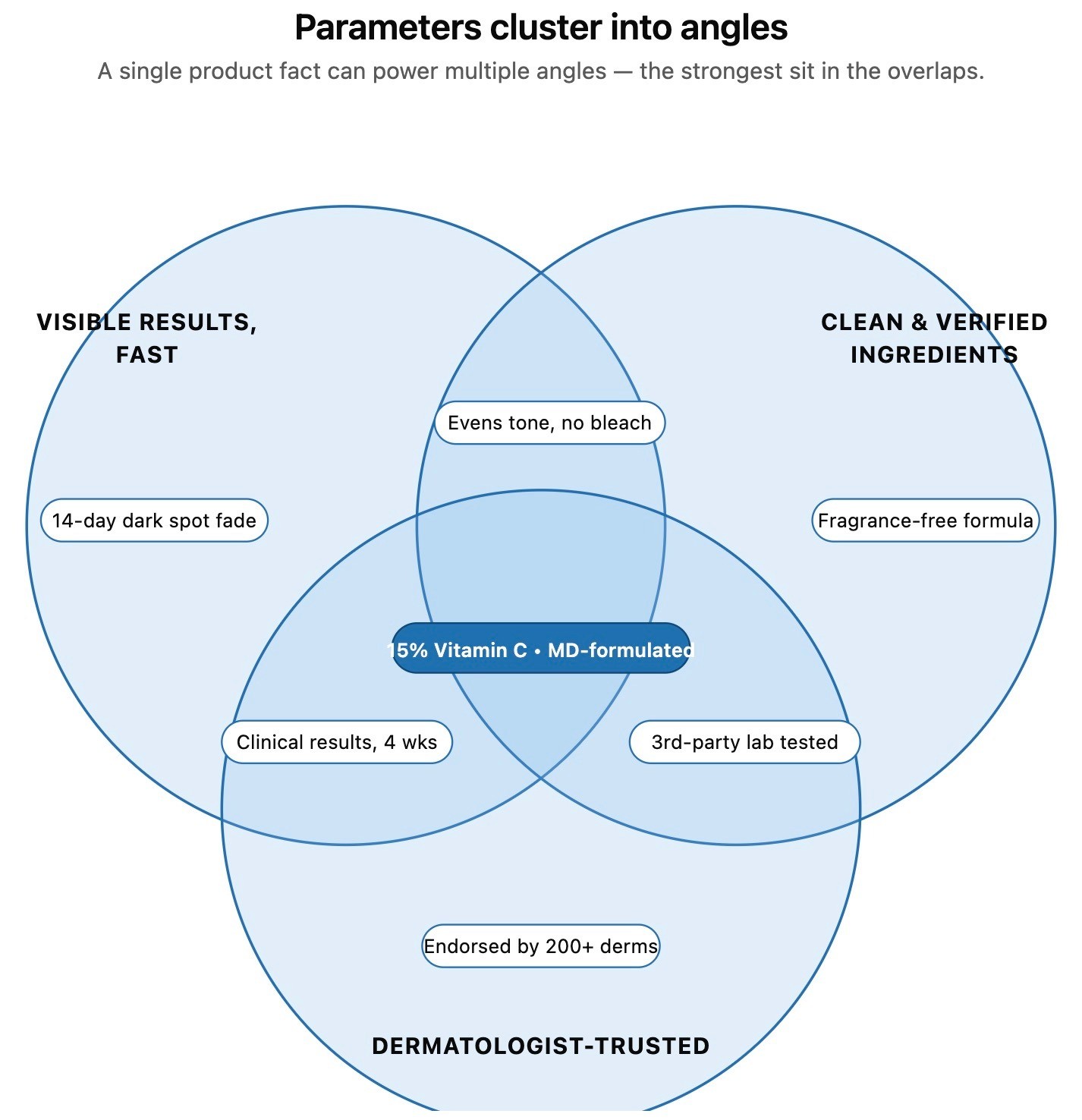
Take a skincare brand with three separate UVPs: "Reduces dark spots in 14 days," "Evens skin tone without bleaching agents," and "Clinical results in four weeks." All three orbit the same promise. You bundle them under one angle: Visible results, fast.
The same product might also compete on ingredient transparency. Parameters like "No parabens, sulfates, or synthetic fragrance" and "Published third-party lab results" group naturally as Clean ingredients you can verify.
Clusters are not mutually exclusive.
Think of the mapping as a Venn diagram, not a grid. A single parameter can appear in multiple angles, and some parameters are so strong they become angles on their own. A seasonal offer like "30% off for summer" becomes its own angle: Summer sale.
Define Your Ideal Customer Profiles
With the ICP, you start reshaping product information into messages meant for someone specific, at a specific moment. An Ideal Customer Profile is a concise description of the people most likely to extract value from your product, whether the product was built for them or they have adopted it in unexpected ways.
Each ICP captures three buckets of traits.
Demographics: Age range, gender identity, and a rough read on income level. A skincare brand might define one ICP as "Women, 28 to 40, mid-to-upper income." Keep it directional.
Behaviors: The actions and routines that influence purchase. Job title or life role, key hobbies and habits, and goals they are actively pursuing. One ICP might be "Working professionals who want a streamlined routine that still delivers results." A second might be "New moms dealing with postpartum skin changes who have no time for a ten-step regimen."
Needs and Pains: Pain points the product can ease, alternatives they already try, and objections that make them hesitate to choose your product specifically.
Language matters across all three buckets. The slang and phrasing a given audience naturally uses should be noted so future scripts can echo it. A headline for working professionals might read "Skip the ten-step routine." For new moms, the same angle becomes "Your skin changed. Your routine should too." Same product, same angle, completely different emotional register.
The angle stays constant while the ICP changes the wording so it feels personal. Some creative structures like a pure discount offer change very little across personas. But testimonial-driven or story-driven ads lean heavily on ICP nuances, and that is where the real performance differences show up.
Choose Your Tactic, Format, and Ad Settings
This is where you move from "what to say" to "how the ad will work." You are now defining the psychological mechanism, the visual format, the tone, the pacing, and the overall shape of each ad.
Tactics
A tactic is the cognitive mechanism that moves someone from curiosity to belief. It governs the message logic, the argument structure, and the emotional register of the ad.
Tactics are modular. Meaning, the same tactic can be expressed through any creative format, so you can keep the psychological intent constant while exploring different visual presentations.
Us vs. Them: Pits your product against an alternative and highlights why your offering is superior. "Them" can be a named competitor or just the old way of doing things.
Myth-busting: Confronts a widely held misconception and replaces it with a verifiable truth tied to your UVP. Viewers feel smart for updating their belief rather than wrong for holding it.
Flip the Script: Hooks with a contrarian or seemingly negative opener, then resolves tension with a positive twist. Especially potent when the category is full of cliched promises.
Spokesperson: Borrows authority from a founder or expert to compress uncertainty. Face-forward framing, clean background, lower-third name and credential.
Transformation: Shows a finished, verifiable outcome that proves the product already worked. The narrative begins after success has happened.
Fear Trigger: Surfaces a specific, likely, near-term risk and immediately pairs it with a simple fix. Ethically executed, it informs without terrorizing.
FOMO: Uses demand as proof to create soft urgency. "This shade has sold out six times." Loss aversion activated through social validation rather than countdown timers.
Educational Authority: Delivers specific, validated information the viewer did not know, turning education itself into persuasion.
Each one is a distinct persuasion mechanism that can be precisely defined, consistently identified across a library of ads, and systematically tested.
Creative Formats
The creative format determines how the ad looks and moves on screen. Changing the format does not change the message logic. It changes how the message is experienced.
Video Explainer: Deep dive into how a product works, using animations, diagrams, or expert narration. Focuses on one feature or mechanism rather than listing every benefit.
First-Person Testimonial: A single person sharing their experience in their own words. Conversational delivery, emotional appeal, one individual's journey for depth.
Multi-Voice Testimonial Montage: Multiple brief testimonials cut together for a cumulative social proof effect. Quick cuts, unified theme, diverse faces.
Listicle: A thematic list of distinct points where the order is interchangeable. "3 reasons," "Top 4 benefits." Each item is self-contained with a small proof cue.
Walkthrough: A sequential demonstration where each step must happen in order. Input leads to state change leads to next input. If you can shuffle steps without breaking it, it is not a walkthrough.
Brand Pitch: Speaks in the brand's voice with a clear promise, light proof, and a direct call to action.
Podcast Bit: A two-person Q&A framed like a clip from a longer show. Dialogue cadence, multicam crops, conversational credibility.
Ad Settings
Beyond tactic and format, every ad carries production-level decisions that shape how it feels.
Tone: The relationship between the messenger and the viewer. Empathetic, educational, encouraging, fun, imperative, or authoritative. Each one changes both the words and the visual style.
Pacing: The tempo of scene transitions and text changes. Slow reads as serious or authoritative. Medium feels conversational. Fast creates energy and high retention.
Visual type: The overall production style. UGC Lo-Fi (authentically unpolished), UGC Hi-Fi (home-based with deliberate craft), Organic/Meme (platform-native and scrappy), Elevated/Cinematic (controlled environment with intentional design), or Animated (motion graphics and designed visuals).
Narration driver: What carries the story forward. Talking to camera, voiceover, on-screen text, trend sound, or music. An ad can shift narration drivers at block transitions.
Talent: Single person, multiple people, or no talent on screen.
Duration: Short (3 to 15 seconds), medium (16 to 30), or long form (31+).
Structure the Narrative With Chapters and Blocks
Once your tactic, format, and settings are locked, you start building the actual ad. The narrative structure defines the order of arguments you deliver to persuade the viewer. It is organized in chapters and blocks.
Chapters
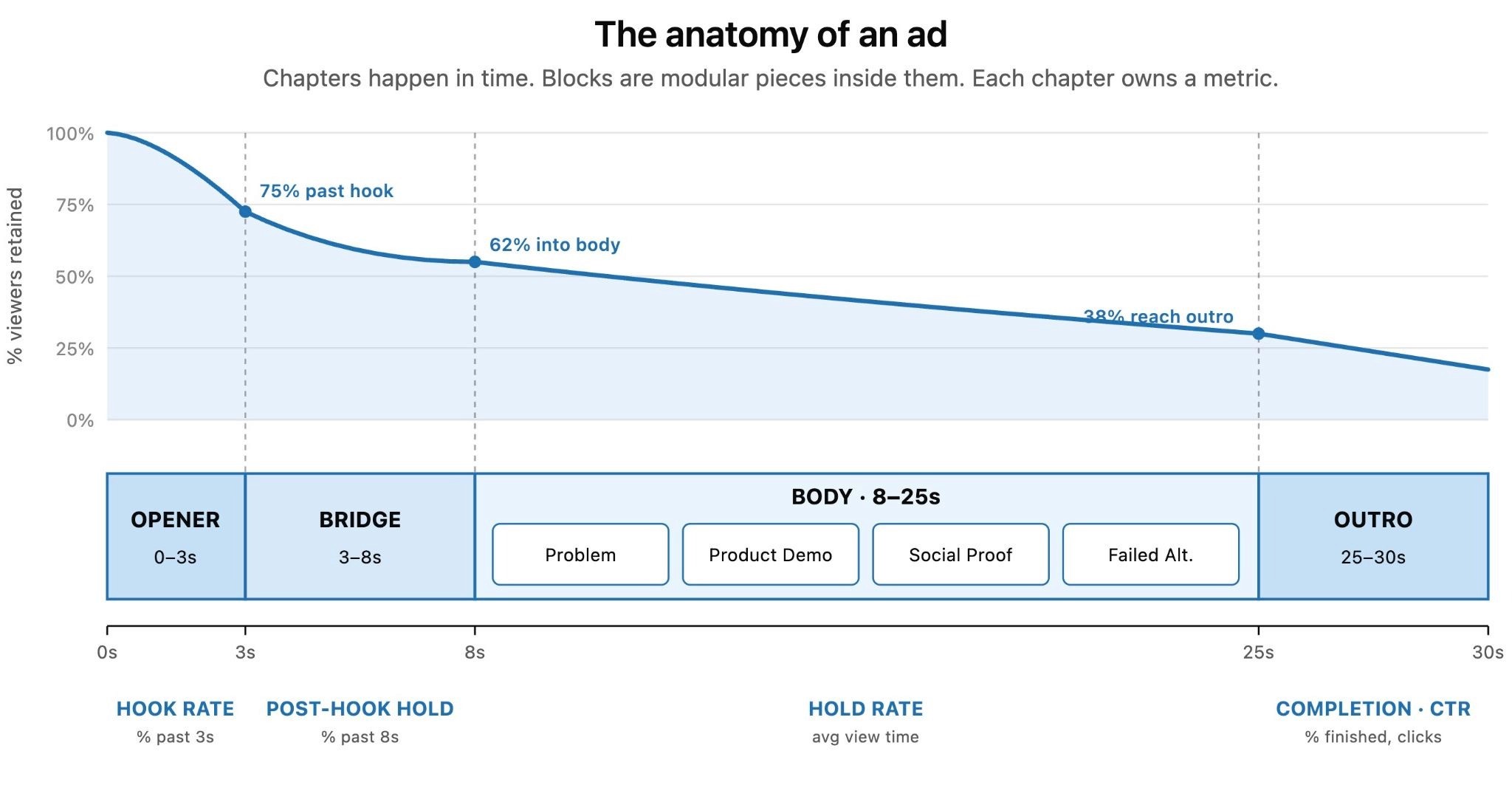
Every ad has up to four chapters, each with a distinct job.
Opener: Grabs attention and conveys the angle. Measured by hook rate or thumbstop rate. The opener is one of the most frequently tested variables in performance creative. It has three components: headline (the first persuasive phrase), visual (what the viewer sees first), and sound (what sets the emotional tone).
Opener visuals work in two modes. Supportive visuals reinforce what the headline says. Disruptive visuals exist purely to stop the scroll so the headline can land.
Bridge: Shifts the viewer from curiosity to information. Measured by post-hook hold rate.
Body: Where persuasion happens. The longest chapter. Whatever makes the viewer believe this solution is better than anything else they have tried lives here. Measured by hold rate and completion metrics.
Outro: Tells the viewer what to do next. A crisp CTA plus any last-minute assurance like a guarantee or offer.
Chapters can collapse as the message tightens. An outro can fold into the final body block. A warm audience might skip straight from opener to offer. The opener is the only chapter that can never disappear.
Blocks
Within chapters, the real argumentative work happens in blocks. Each block lands one argument. The moment that argument is delivered, the block ends. Blocks are modular, meaning you can lift, swap, or delete them without breaking the ad's logic.
The core block types are:
Solution / After: Shows the positive end-state the viewer wants
Problem / Before: Names the pain the product removes
Product Demo: Shows how the product works, demonstrates a step, or names a feature or value proposition
Social Proof: Proves other people already trust or benefit. Each source of validation is a separate block.
Failed Alternative: Singles out a competing option and brands it as ineffective
Rebut Objection: Dispels a misconception that blocks purchase
Product Offer: Gives a time-bound reason to act now
CTA: Tells the viewer exactly what to do next
These blocks snap together in predictable patterns. An intro might combine Problem plus Solution. The body can mix Demo, Social Proof, Failed Alternative, or Rebut Objection in whatever sequence fits the tactic. The outro usually closes with Offer plus CTA.
Build a Testing Strategy That Compounds Learning
Building one ad is a starting point. The framework becomes valuable when you use it to generate structured variations and learn from each one systematically.
Move Beyond One-Variable-at-a-Time Testing
Meta's Andromeda retrieval system uses visual and text embeddings to evaluate ad similarity. When you test different hooks without changing the visuals, or swap a single line of copy while keeping everything else identical, Andromeda may treat those variations as nearly the same ad and distribute them to overlapping audiences. The brands that scale creative profitably focus on genuinely diverse concepts, not subtle tweaks to the same base ad.
Ad Families
Ads exist within groups called ad families. Each family keeps the same core message while changing specific elements to observe their effect. The pillars that define a family are angle, opener, and ICP. As long as two of those three stay fixed, all resulting ads belong to the same family.
Single-Variable Testing
Isolates one narrow parameter to validate its direct influence on performance. The best candidates are aesthetic style, opener elements, duration, and block-level arguments like swapping one pain point for another within the same narrative slot.
Multi-Variable Testing
Explores different ways to deliver the same concept by modifying several creative layers at once. The most influential parameters here are tactic, creative format, narration driver, visual type, and talent. If both the angle and the ICP change at the same time, you are no longer testing a variation. You are creating a new concept.
Iteration
Iteration is reactive. It responds to what performance data reveals about existing ads, building on validated winners to extend their lifespan and optimize results.
The logic is "protect what converts, refresh what decays." You might update visuals while keeping the same messaging. Or swap footage but preserve the voiceover untouched. Or recut the opener based on hook-rate data.
Performance metrics guide every decision. Hook rate informs opener adjustments. Post-hook retention signals whether pacing or block order should shift. Average view time shows where viewers drop off so subsequent iterations can address that exact moment.
An iteration becomes its own ad family. It is not a single update but the starting point for a new generation of ads derived from a validated winner.
How Airpost Puts This Framework Into Practice
The hardest part of creative strategy is not building the framework. It is sustaining it. Even teams that map out their angles, ICPs, and tactics thoroughly run into the same wall: they cannot produce enough genuinely different ads to keep up with what the framework demands. Agencies deliver a handful of concepts per cycle. Internal teams burn out trying to cover every combination of tactic, format, and audience. The testing roadmap fills up faster than the creative pipeline can move.
Meanwhile, Meta's algorithm rewards volume that is actually diverse. Running five variations of the same testimonial ad does not give Andromeda much to work with. You need distinct concepts, not just different thumbnails, and you need them every week without letting quality or brand consistency slip.
That is what Airpost is built for. It is a hybrid AI engine built for producing ads, and is managed by expert creative strategists. Here is what the platform delivers:
10 to 30 new video ads per week, each editable and built from your brief
A proprietary ad taxonomy that categorizes every creative by format, hook type, angle, tactic, ICP, narration driver, visual style, and performance patterns. The taxonomy drives strategy forward by identifying whitespace and surfacing untested combinations rather than just labeling ads after the fact.
A living brief that evolves based on performance data. When you adjust the brief, the ads Airpost delivers adjust with it.
24/7 performance monitoring that triggers new variations and concepts when an ad starts winning
A library of 300,000+ real footage clips alongside your own assets and AI-generated footage
Automatic resizing to vertical and square formats with repositioned text and optimized safe margins
Brand safety and compliance with a built-in Disclaimers feature
Dedicated creative strategists who translate taxonomy insights and performance data into scripts, shot selections, and finished ads. No prompting required.
Airpost functions as a creative production layer that fills the volume gap so your existing resources can focus on direction and brand-level decisions.
It is best for enterprise brands with significant Meta and TikTok ad spend who need high-volume creative without sacrificing brand integrity or strategic rigor.
Book a demo to see how Airpost can turn your creative strategy into a steady stream of performance-ready ads.