The biggest constraint on Facebook ad performance in 2026 isn't targeting, budget, or even creative quality. It's creative volume. Meta's delivery system needs a steady stream of distinct concepts to optimize effectively, and most teams can't keep up. They're stuck in a cycle of slow production, recycled ideas, and diminishing returns.
This guide covers the campaign infrastructure and creative strategy you need to break out of that cycle and build campaigns that keep converting.
1. Set Up Your Campaign for Success
Before you think about creativity, your campaign structure needs to be right. Meta has published clear best practices here, and they're worth following. Brands that ignore account structure waste budget before a single ad plays.
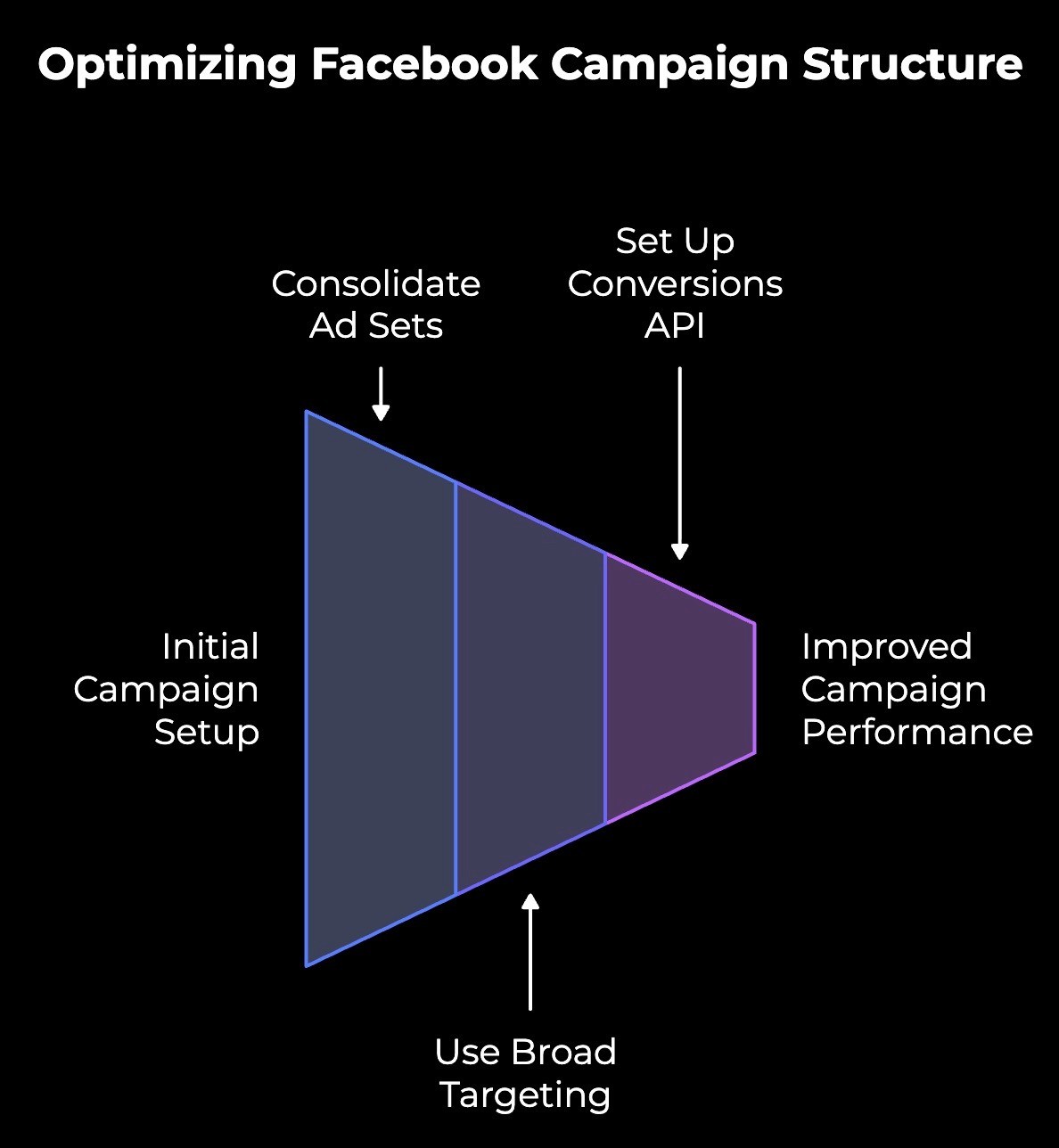
a) Consolidate Your Ad Sets
Running multiple ad sets with similar audiences and creative fragments your budget and slows down the learning phase. Meta's internal data show that small businesses using simplified account structures achieved an average CPA 18% lower than campaigns that didn't.
The fix is straightforward:
Combine ad sets that use similar creative into fewer, better-funded groups.
Avoid overlapping audiences across ad sets. Overlap forces your own ads to compete against each other in the auction.
Turn on the Advantage campaign budget so Meta's system allocates spend to the ad set that's performing best.
b) Use Broad Targeting
This one feels counterintuitive, but the data is clear. Small businesses using broad targeting (location, age, or gender only) achieved a 12% lower CPA compared to campaigns with narrow interest-based targeting. Meta's delivery system has gotten good enough at finding buyers within large audiences that heavy targeting restrictions often do more harm than good.
If your business has a narrowly defined audience, turn on Advantage detailed targeting to let the system explore beyond your initial parameters when it spots conversion potential.
c) Set Up the Conversions API
The Conversions API sends event data directly from your server to Meta, rather than relying solely on browser-based tracking through the pixel. Use both together. This gives the delivery system more complete data on which users are converting, thereby improving optimization and lowering CPA over time.
2. Build Video Creative the Algorithm Rewards
Campaign structure gets your ads into the auction efficiently, while creative determines whether they win. This is where most teams underperform, not because they lack talent, but because they follow outdated testing advice.
a) Why "Test One Variable at a Time" No Longer Works
Meta's own sales playbook recommends testing one variable at a time in A/B tests. That advice made sense for a simpler auction system. It doesn't hold up under Andromeda, Meta's current ad retrieval engine.
Andromeda uses visual and text embeddings to evaluate every creative. It converts your video into a numerical fingerprint and compares it against every other ad competing for the same audience. When two ads have similar embeddings, the system treats them as near-duplicates and restricts distribution for the weaker one.
The practical implication: if your "test" is swapping one hook on an otherwise identical video, the algorithm may not see it as a new creative at all. You end up competing against yourself.
What the algorithm actually rewards is creative diversity. Genuinely distinct concepts, not subtle tweaks, give the delivery system more signal to work with and accelerate its ability to match the right message to the right person.
b) Make It Mobile-First
This one aligns with Meta's playbook, and it's non-negotiable. The majority of Facebook and Instagram users browse on mobile, and your video creative needs to reflect that.
Shoot vertical (9:16 for Reels and Stories, 4:5 for feed).
Put your brand or key message in the first three seconds. Attention drops fast.
Mix static and video assets in the same ad set so Meta can serve the right format in the right placement.
Add audio, whether that's voiceover, original sound, or music. But design for sound-off too, with captions and text overlays that carry the message visually.
c) Structure Your Video for Retention
Getting someone to stop scrolling is one challenge. Keeping them watching long enough to act is another. High-performing Facebook video ads follow a clear internal structure:
Opener: You have roughly two seconds to earn the next ten. The opener combines a headline (the first persuasive phrase), a visual (something that sparks relevance or disrupts the scroll), and sound. This is the most frequently tested element in performance creative because it directly drives hook rate.
Bridge: Shifts the viewer from curiosity to context. Answers "why should I keep watching?" Measured by post-hook hold rate.
Body: Where persuasion happens. Product demos, social proof, testimonials, comparisons. Usually, the longest section is the most variable in structure.
Outro: A clear call to action plus any last-minute reassurance like a guarantee or offer. Keep it tight.
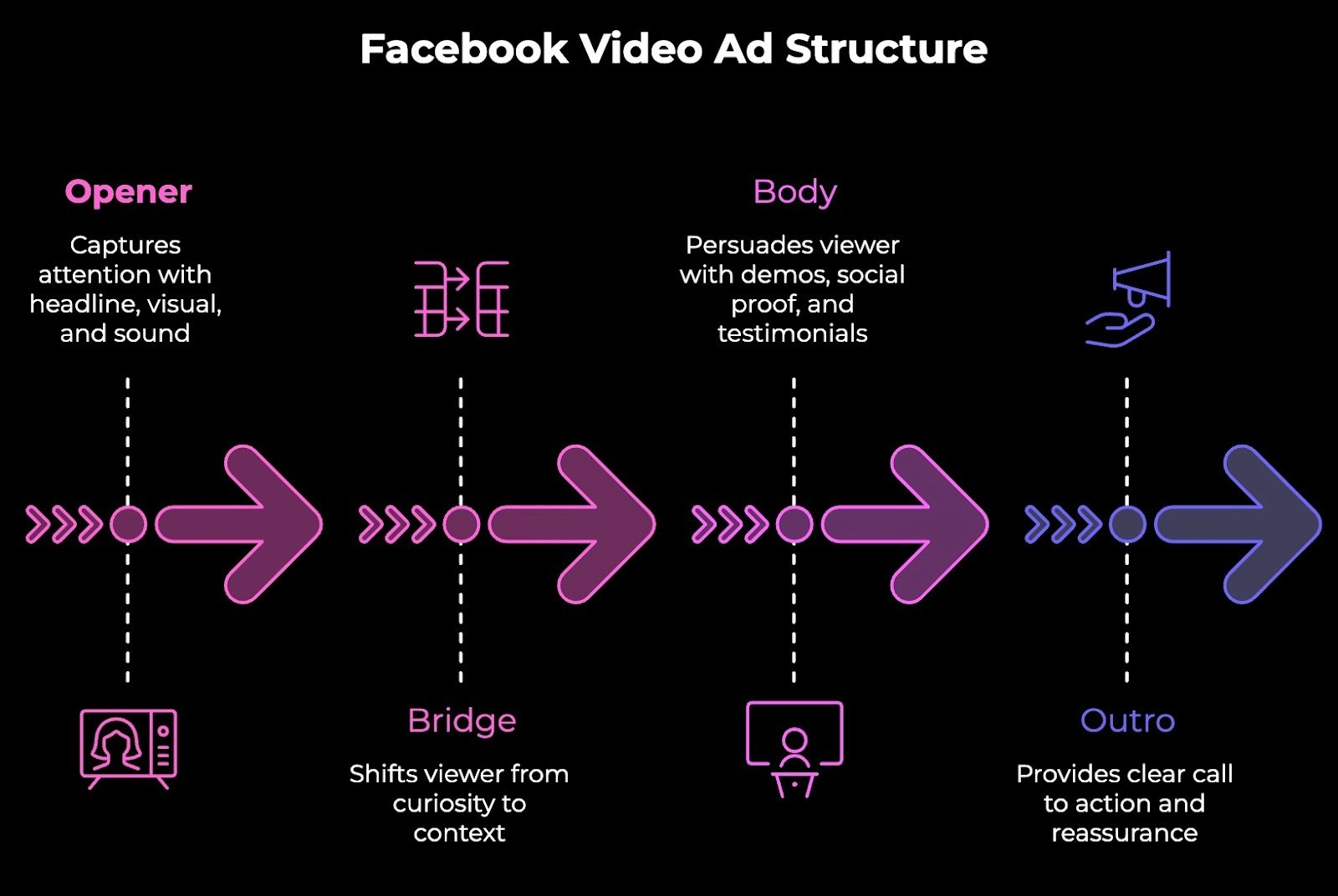
These sections aren't rigid. For retargeting audiences, the body might shrink because the viewer already knows the product. For cold traffic, you might extend the bridge. The only non-negotiable is the opener: without a hook and a clear angle, you don't have an ad.
3. Layer in Strategic Depth with Angles, ICPs, and Tactics
The difference between a team that produces more video and one that produces video that converts comes down to how systematically they approach creative decisions.
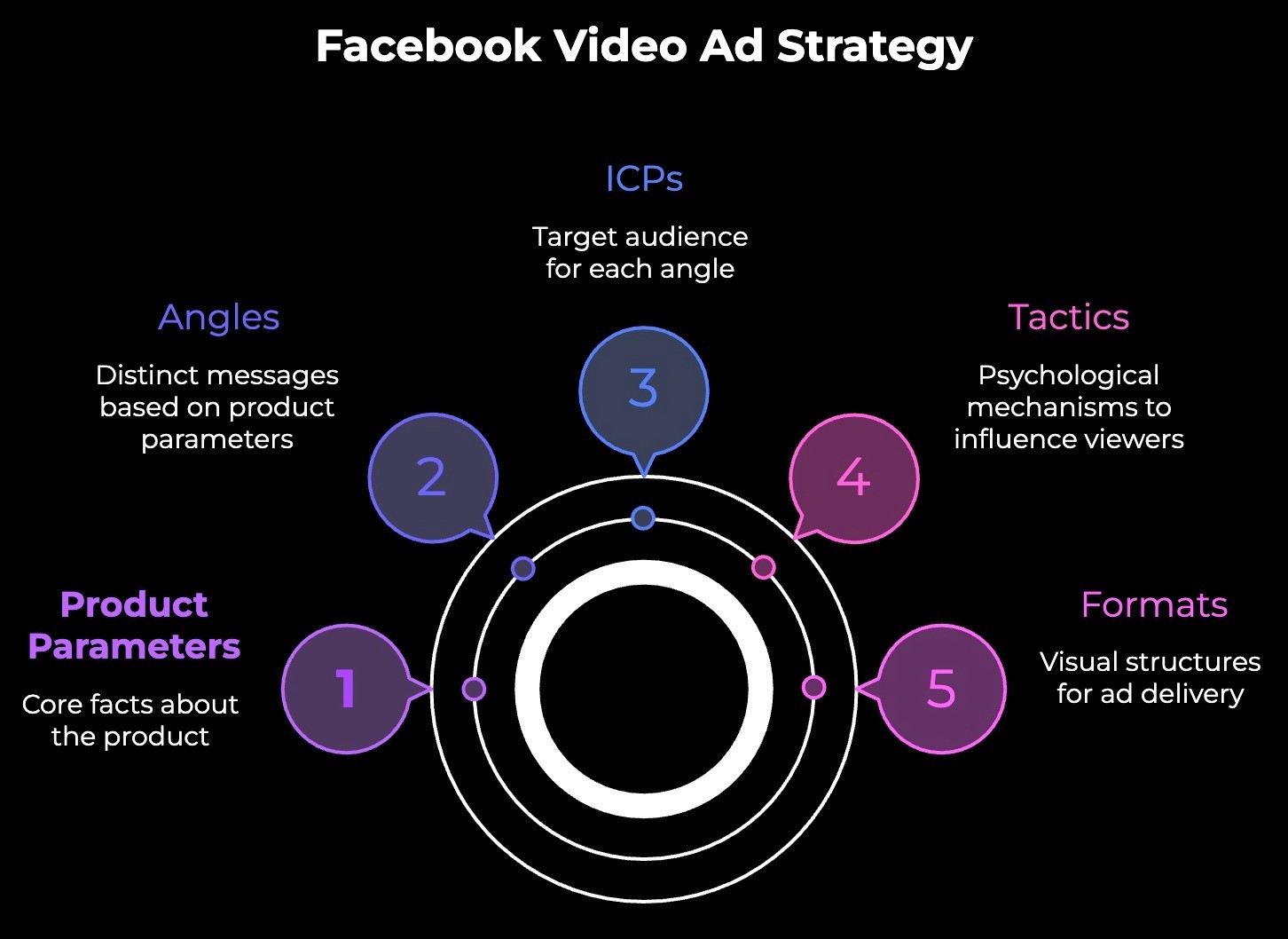
a) Start with Product Parameters and Angles
Every effective ad starts with facts. Document your product's unique value propositions, problems it solves, key features, steps to use, social proof, and active offers. These become your raw material.
From there, cluster related parameters into angles. A weight-loss brand might have separate angles for "affordable alternative to injections," "clinically backed results," and "no lifestyle overhaul needed." Each angle is a distinct, testable message.
b) Aim Each Angle at a Specific ICP
An angle only converts when it's aimed at a specific person. Your Ideal Customer Profile defines who that is, broken into demographics, behaviors (job, habits, goals), and needs (pain points, failed alternatives, objections).
The same angle flexes for different ICPs. A phone case brand pitches "always within reach" as "never miss a boarding scan" for travelers and "don't miss any more firsts" for parents. Same message, different language.
c) Multiply Creative Through Tactics and Formats
A tactic is the psychological mechanism behind the ad: myth-busting, social belonging, transformation proof, and us vs. them. A creative format is the visual structure: testimonial, explainer, listicle, montage, brand pitch.
These layers are independent. One myth-busting angle can run as a talking-head testimonial and as an animated explainer. Separating tactic from format multiplies the number of genuinely distinct creatives you can produce from a single angle, which is exactly what Andromeda needs to optimize effectively.
4. Keep Campaigns Converting Over Time
Launching a batch of video ads is the start. The campaigns that sustain performance share common traits in their iteration.
a) Feed the Algorithm Diverse Concepts
Every new batch should explore a different combination of angle, ICP, tactic, or creative format. If your last batch tested "affordability" for price-sensitive buyers using testimonials, your next batch should explore "clinically backed results" for skeptical professionals using an explainer format.
b) Iterate on Winners
When an ad starts performing, extend its lifespan without breaking what works:
Refresh footage while keeping the same script and voiceover.
Recut the opener based on hook-rate data.
Swap the tactic while keeping the same angle and ICP.
Combine the opener of one top performer with the body of another.
Protect what converts, refresh what decays. Hook rate flags opener issues. Post-hook retention flags bridge or body problems. Average view time tells you if the ad is too long or too short.
Build Facebook Video Campaigns That Actually Scale
Producing this volume and diversity manually is where most teams stall. And even if you use self-serve AI video tools, you'll hit a ceiling fast. They can generate footage, but they can't develop a creative strategy, maintain a consistent brand tone across hundreds of ads, or manage compliance.
That's the problem Airpost solves. Airpost delivers 10 to 30 done-for-you video ads per week through a hybrid engine that combines AI production with expert creative strategists. You set a living brief, and the system builds, tests, and iterates on your behalf.
What sets Airpost apart is its proprietary ad taxonomy. Every creative is categorized by angle, ICP, tactic, creative format, hook type, and performance pattern. This framework identifies white space in your strategy: which audience-message combinations haven't been tested, which formats are underexplored, and where the next winning concept is most likely to come from.
The engine draws on over 300,000 real-footage clips, generates AI-generated footage for your products, monitors performance 24/7, and triggers new variations when ads start winning. Creative strategists validate every output for brand safety, compliance, and enterprise-grade quality.
Book a demo to see how Airpost builds diverse, high-volume Facebook video campaigns that keep converting.